


Globe Valve Materials: Stainless Steel vs Carbon Steel

A globe valve is what you fit when a line has to be shut off tightly and, often, regulated. It costs more pressure than a gate valve and gives back usable control and reliable tight shutoff. Because it gets operated, its body material has to survive both the medium and the wear at the seat — which is why carbon steel versus stainless steel matters more here than on most isolation valves.
What Makes a Globe Valve Different
A globe valve moves a plug perpendicular to a seat ring, and the flow turns through the body in an S. That change of direction produces the higher pressure drop, and it is also what makes the valve usable for throttling: the plug can sit anywhere in the travel without the flow becoming unstable.
Body shape follows duty. A straight pattern is compact; an angle pattern replaces an elbow; a Y-pattern reduces pressure drop at the cost of a longer body. Flanged ends to ASME B16.5 or EN 1092-1 are normal above DN50, and BS 1873 or EN 13709 cover the flanged steel designs.
Why the Body Material Matters Here
A globe valve works harder than a gate valve. The seat takes the erosion of every throttling position, the trim sees velocity rather than static pressure, and the body walls around the seat are thinner than a gate body of the same size. The body is also the part you cannot renew: seats can be replaced and trim and packing renewed, but a corroded or eroded body means a new valve.
So the question is not whether the metal is strong enough, but whether it will survive the medium and the atmosphere between shutdowns while the trim does its work inside it.
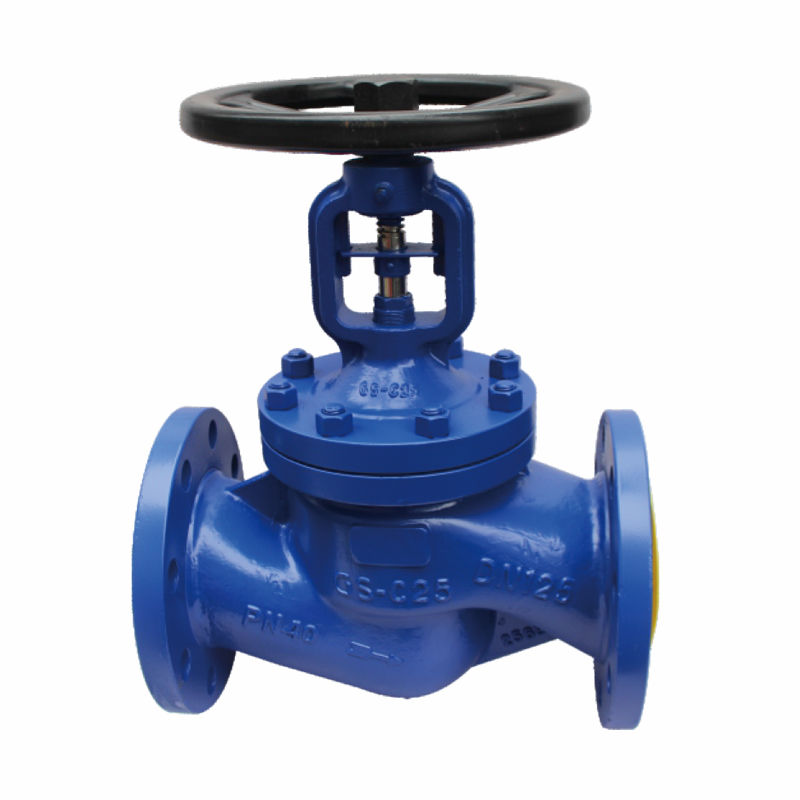
Carbon Steel Globe Valves: WCB, WCC and GS-C25
The standard carbon steel casting is ASTM A216 WCB, with WCC where more strength is wanted; the European equivalent is GS-C25 to EN 10213, the same material marked in a different system. Small-bore compact globe valves are usually forged from A105.
Carbon steel is correct for steam and everything around it: saturated and superheated steam, condensate, boiler feedwater, blowdown, hot oil, compressed air and dry non-aggressive process lines. It holds allowable stress to about 425 °C under ASME B16.34, well above where austenitic stainless begins to lose rating, and costs a fraction of stainless.
Its weakness is water. Condensation, wet standby and humid or coastal air rust a carbon steel body from the inside, and internals are uncoated even when the outside is painted. On steam that hardly matters, because the line is dry and hot. On a continuously wet line it matters a great deal.

Stainless Steel Globe Valves: CF8 and CF8M
Stainless globe valves are cast in ASTM A351 CF8 (the 304 family) or CF8M (the 316 family), with CF3M and duplex for aggressive service. Compact forged versions use A182 F304 or F316 bar.
CF8M carries molybdenum, which resists chlorides, and that difference decides most specifications. Stainless suits chemical and petrochemical service, pharmaceutical and food contact, demineralised and potable water, acid and caustic dosing, brine lines, and any outdoor or coastal installation where repainting is not realistic.
Two limits follow. Austenitic grades derate faster than carbon steel, so a Class 150 CF8M valve at 400 °C carries far less pressure than the WCB equivalent, and the grade is wrong for long exposure above about 425 °C. Stainless also galls: a stainless plug in a stainless seat can seize, which is why seat faces are hard-faced or the trim is specified in another grade.
Bellows Seal: Removing the Stem Leak Path
The most valuable version of this valve is the bellows-sealed one. Instead of relying on packing around a moving stem, a welded metal bellows isolates the stem from the atmosphere, so the only leak paths left are the seat and the body joints. On steam, thermal oil, ammonia, chlorine and any expensive or hazardous medium, that removes the end of the valve that normally leaks first.
Bellows-sealed globe valves are standard on steam headers, tracing lines and drain points where a dripping gland is unacceptable. The limits are practical: the bellows restricts travel, so sizes stay modest, and it is a fatigue-limited component rather than a renewable gasket — cycle count matters, and it is not something you replace on site.
Choosing Between the Two Materials
The decision follows the medium, not the budget. Choose carbon steel where the duty is hot and dry: steam, condensate, boiler feedwater, heat transfer oil, dry air and non-aggressive hydrocarbons. Choose stainless where the medium is wet, acidic or chloride-bearing, and where the valve sits in a marine or chemical atmosphere.
Where the two overlap, the trim offers a middle path. A carbon steel body with a stainless or hard-faced trim is common on steam and hot oil because it puts the corrosion resistance where the wear is, without paying for an austenitic casting.
Pressure and Temperature Ratings
Both materials use the same ASME B16.34 tables, so the flange class is identical at ambient temperature and the difference appears as temperature rises. WCB keeps close to full rating to about 300 °C and is permitted to 425 °C. CF8M is permitted to roughly 538 °C, but its allowable stress drops steeply above about 200 °C.
Practical consequences follow. Steam above 400 °C in a stainless valve usually means a higher class, a smaller size or a different material. Hot service needs graphite packing and a spiral-wound or ring-joint bonnet gasket. Any valve operated for regulation should be rated on the throttled condition, not the settled line pressure.
Trim, Seat and Disc Options
The trim decides whether the valve regulates well and how long it lasts. Standard trim is 13 % chromium; 316 stainless is used for corrosive service; Stellite facing is specified for steam, flashing condensate and abrasive duty. Trim numbers under BS 1873 or API standards specify the combination in one line.
Disc design sets the characteristic. A contoured plug gives a linear or equal-percentage curve for regulation; a composition disc in PTFE or rubber gives tight shutoff at lower temperature; a needle plug meters small flows. Seat tightness is quoted to ANSI/FCI 70-2 — Class IV for metal seats, Class VI for soft. Sizing belongs on Cv or Kv and the required characteristic, not on nominal size.
Cost, Life Cycle and the Honest Comparison
A CF8M body costs roughly two and a half to four times the WCB equivalent at the same size and class. The comparison that matters is not the two purchase prices but the cost of taking the line down. A globe valve is serviced more often than a gate valve, and a bellows valve that has reached its cycle limit is replaced rather than repacked.
That points two ways. On dry, hot, benign duty, carbon steel with a good trim is the economical answer; stainless is money spent on protection the valve does not need. On wet or chloride-bearing duty, a carbon steel body that corrodes at the seat in two or three years costs far more than the stainless valve that would have outlasted the plant.
Five Specification Mistakes
Choosing a globe valve to isolate a large line. It costs several times the pressure drop of a gate valve, and more money. Use it where regulation or tight shutoff is needed.
Soft seats on steam. A PTFE or rubber disc gives Class VI shutoff on water but fails at steam temperature; steam needs a hard-faced metal seat.
Specifying WCB for wet chloride service. Wet standby, dosing lines and coastal air attack carbon steel from the inside, and there the body material is the decision.
Sizing by nominal size instead of Cv. Capacity depends on the trim and characteristic, not the bore; a valve chosen by DN alone either throttles permanently or never passes the flow.
Ignoring bellows life. A bellows-sealed valve removes the packing leak but adds a fatigue-limited part; where the valve cycles often, the bellows is the maintenance item.
FAQ
Should I choose a stainless steel or carbon steel globe valve?
Carbon steel (WCB or GS-C25) for steam, condensate, hot oil and dry duty; stainless (CF8M) where the medium is wet, acidic or chloride-bearing, or the valve sits in a coastal or chemical atmosphere.
Can a globe valve be used for throttling?
Yes — that is its main advantage over a gate valve. The plug holds any position in the travel, but sizing must be based on the throttled condition and the required flow characteristic.
What is a bellows-sealed globe valve for?
It replaces stem packing with a welded metal bellows, removing the commonest leak path on steam and hazardous service. The trade-offs are limited travel and a fatigue-limited bellows.
Do globe valves have a higher pressure drop than gate valves?
Yes, considerably. Flow changes direction twice through the body, so the loss is several times that of a straight-through gate or ball valve of the same size.
Specification Checklist
Size, flange standard and class, and face-to-face dimension standard.
Body material stated as a grade — A216 WCB, GS-C25 or A351 CF8M.
Trim number covering stem, disc and seat facing, hard-faced where needed.
Disc design and flow characteristic for the intended regulation.
Seat leakage class to ANSI/FCI 70-2.
Bonnet type: bolted, bellows seal or welded, with packing or gasket materials.
Operator: handwheel, gearbox or actuator pad, sized on the throttled condition.
The Short Version
A globe valve earns its higher pressure drop by regulating and shutting off tightly, and its body is the one part that cannot be renewed. Carbon steel WCB and GS-C25 suit steam, condensate and hot oil because they keep their rating to 425 °C and cost a fraction of stainless. CF8M suits wet, acidic and chloride-bearing service, but derates faster as temperature rises. Put the corrosion resistance where the wear is — in the trim — and the body material becomes an easy decision.

Comments