


Ball Valve End Connections: Flanged, Threaded or Welded

A ball valve is usually chosen for what is inside it — the ball, the seats, the body material — while the end connection is treated as a detail. It is not. The same DN25 stainless ball valve with threaded, flanged or welded ends is three different products: different installed cost, different leak risk, different maintenance, and in some services only one is acceptable.
What the End Connection Actually Decides
The ends are what let the valve join the pipe. Beyond that, the end type decides three things that turn up on the maintenance bill.
The number of leak paths. A flanged valve brings two bolted joints with it — two gaskets and a ring of studs. A threaded or welded valve adds none.
Whether the valve can be removed. A flanged or threaded valve unbolts or unscrews and is replaced. A welded valve cannot, without cutting the pipe.
What the joint does to the metal. Threads cut into the wall and leave a spiral crevice; welds change the structure of the metal beside them. Both are more serious on stainless than on carbon steel.
Flanged Ends: The Default Above One Inch
Flanged is the standard choice from about 1 inch upward, and for anything that has to be removed or inspected. The valve carries two flanges — raised face, flat face or ring joint — and bolts to matching pipe flanges with a gasket between.
The advantage is serviceability: a flanged valve comes out of the line with hand tools, and the joint can be re-tightened if it weeps. High pressure and a wide temperature range need no special preparation.
The cost is weight and hardware — two flanges, two gaskets and a set of studs. Above Class 600, or in strongly cyclic thermal service, the bolted joint becomes the part most likely to need attention, which is also why it is the easiest to work on.

Flange Standards Do Not Interchange
Two flanges can look identical and still not fit. ASME B16.5 is the US system, quoted by class. EN 1092-1 is the European system, quoted by PN. Bolt circle, bolt diameter and facing profile all differ.
Class 150 and PN16 are not interchangeable even though they are broadly comparable at ambient temperature — on many sizes the bolt holes do not line up. Face-to-face length differs too, ASME B16.10 against EN 558.
State the standard, the class or PN, the facing and the face-to-face dimension. A valve described only as "DN50 flanged" leaves four ways to get it wrong.
Threaded Ends: Small Bore and Utility
Threaded ends belong to small bore — normally 1 inch and below — and to instrument, panel, utility and light process duty. They need no welding and no gaskets, and a threaded valve can be fitted with a wrench.
The limit is the thread. A cut thread removes wall thickness and leaves a crevice that follows the helix, which is where corrosion starts. Threaded joints also behave badly in cyclic thermal service, because differential expansion works the joint loose, and they are not accepted for most hazardous duties.
The thread system must be written down. NPT is the US tapered thread, BSPT the British tapered thread, BSPP the British parallel thread. The two tapered forms seal on the thread flank at different angles, so an NPT male will start into a BSPT female for a turn or two and then bind without ever sealing. BSPP seals on a face or a washer instead.
Welded Ends: Socket, Butt and Fully Welded
Welded ends take the joint off the leak list. There are two forms, and a third applied to the whole valve.
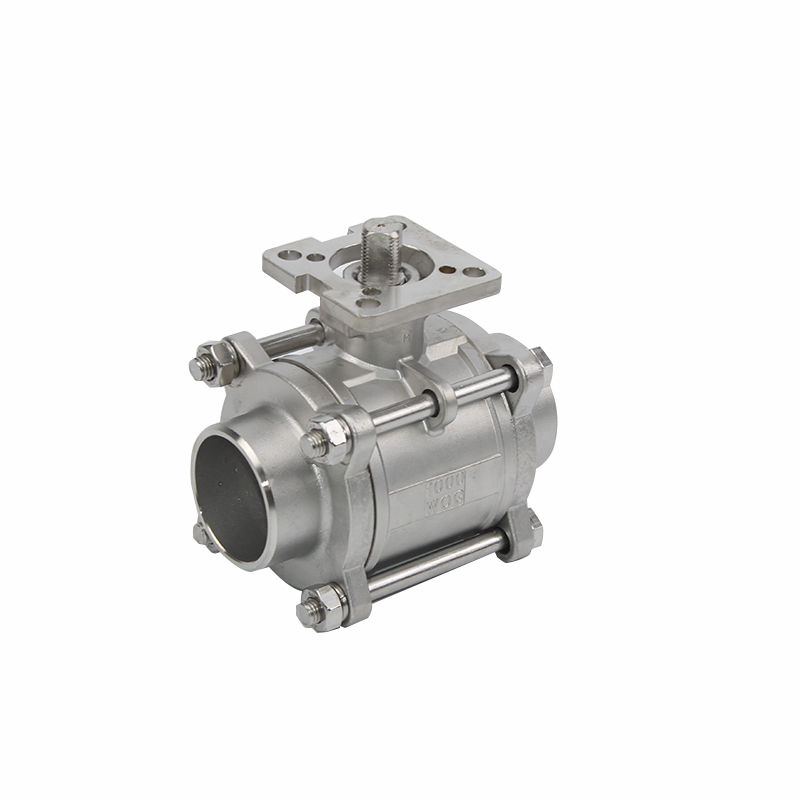
Socket weld ends, to ASME B16.11, are used up to about 2 inch: the pipe slips into a recess and is fillet-welded outside. It is quick and forgiving of fit-up, but leaves an internal gap where the medium can stagnate, so socket welds are avoided in crevice-sensitive service.
Butt weld ends, to ASME B16.25, match the pipe bore and take a full-penetration weld with no internal crevice — the standard for larger sizes, for services that will be radiographed, and wherever flow must be undisturbed.
Fully welded ball valves weld the body sections instead of bolting them, so no gasket and no bolted joint remains anywhere. They are specified for buried pipelines, gas networks, district heating mains and any position where access for maintenance is impossible.
Stainless and Carbon Steel at the Joint
The end type forces different material decisions, and this is where most of the trouble starts.
On stainless steel, threads gall. A 316 male thread run into a 316 female without a lubricating sealant seizes and tears, and the joint has to be cut out of the line. Use PTFE tape or an anaerobic sealant on every stainless thread, and never make one up dry and hard.
Welding changes the metal beside the weld. Standard 304 and 316 can be sensitised when the heat-affected zone sits in the critical temperature range, leaving the grain boundaries open to attack, so welded stainless is normally ordered in the low-carbon grades 304L and 316L. The weld also has to be cleaned and passivated afterwards; heat tint and embedded iron left on the surface become the start of pitting.
Carbon steel takes threads and welds easily, but brings two problems. A carbon steel valve bolted to a stainless flange makes a galvanic couple, and the carbon steel corrodes preferentially unless the joint is isolated with an insulating gasket kit and sleeved studs. And welding burns off coatings, so a painted or galvanised valve carries a bare ring at every weld — under insulation, that ring becomes corrosion under insulation.
Which End for Which Service
Small bore instrument, gauge, panel, drain and utility lines: threaded, with the thread system stated.
General process duty and sizes above 1 inch: flanged to the plant standard.
Buried, inaccessible, hazardous or zero-leak service: weld ends, or a fully welded valve.
Cyclic thermal service: flanged with a suitable gasket, or welded — not threaded.
Stainless above 2 inch: flanged or butt weld, to avoid galling and crevice corrosion at threads.
Pressure, Temperature and Rating
The end connection sets the practical limit as much as the body does. A threaded joint is usually the weakest point in a small-bore line, because the thread reduces the wall and there is no gasket to spread the load. A flanged joint follows the flange class, with a gasket rated for temperature, not just pressure. A correctly made weld end is as strong as the pipe.
The body still follows the same ASME B16.34 table whatever the ends, so a 1000 WOG threaded valve and a Class 150 flanged valve are not alternatives at the same rating: WOG is a cold working pressure, a class is a pressure-temperature rating that falls as temperature rises.
Cost, Weight and Installation
Ranked by installed cost for the same body, threaded is cheapest and lightest, flanged costs more in hardware and space but stays flexible, and welded costs least in hardware but needs a coded welder and, often, inspection by radiography or dye penetrant.
The trap is comparing purchase prices. A DN25 threaded and a DN25 butt-weld valve may cost about the same, but the weld costs several times the threaded joint and cannot be undone.
Five Specification Mistakes
Ordering by size and material alone. "DN25 stainless ball valve" identifies nothing. End type, thread system or flange standard, class, port and body grade all belong on the line.
Mixing flange standards. Class 150 and PN16 are not interchangeable, and the bolt circles differ before the facings are even considered.
Threading stainless steel without anti-seize. The threads gall, the joint seizes, and it has to be cut out of the line.
Using 304 or 316 where the valve will be welded. Specify 304L or 316L and require post-weld cleaning and passivation.
Bolting carbon steel to stainless without isolation. The galvanic couple corrodes the carbon steel, and the failure gets put down to the wrong cause.
FAQ
Which is better, a flanged or a threaded ball valve?
Neither in general. Flanged for sizes above about 1 inch, higher pressure and valves that will be maintained; threaded for small bore instrument and utility duty where the joint is not cycled.
Can a welded ball valve be repaired?
Only by cutting it out of the line. That is why welded and fully welded valves are chosen for buried or inaccessible service, and why weld quality and inspection are specified up front.
What is the difference between NPT and BSP threads?
NPT is the US tapered thread with a 60-degree form; BSPT is the British tapered thread with a 55-degree form. They are not interchangeable — an NPT male will bind in a BSPT female without sealing.
Why specify 316L instead of 316 for a welded valve?
The lower carbon content prevents sensitisation in the heat-affected zone of the weld, which would otherwise leave the grain boundaries open to corrosion.
Specification Checklist
End type stated: flanged, threaded, socket weld, butt weld or fully welded.
Flanged: standard, class or PN, facing, and face-to-face dimension.
Threaded: NPT, BSPT or BSPP, and male or female.
Welded: weld standard, pipe schedule or wall thickness, and inspection requirement.
Body grade and trim stated separately, with 304L or 316L where welding is involved.
Gasket, studs and isolation kit specified where carbon steel meets a stainless flange.
Buried or inaccessible valves ordered fully welded and factory pressure-tested.
The Short Version
The end connection is not an afterthought. It decides how many joints can leak, whether the valve can be taken out at all, and what the joint does to the metal beside it. Flanged is the default above an inch and the right choice wherever the valve will be maintained; threaded belongs to small bore utility duty and only with the thread system written down; welded ends remove the joint and the maintenance with it. Watch galling at stainless threads, sensitisation at stainless welds, the galvanic couple when carbon steel bolts to stainless, and the coating burnt off at every carbon steel weld.


Comments